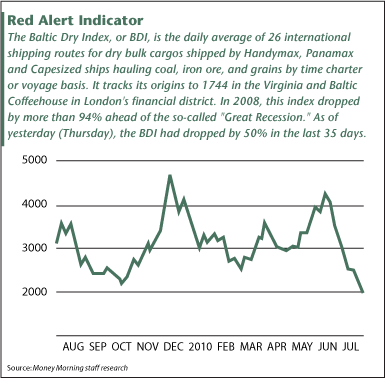
The Baltic Dry Index (BDI) flashed serious warning signals ahead of the 2008 financial crisis. After dropping for its 35th-straight day yesterday (Thursday), what is this thinly followed index telling us now? Back in May 2008, when global investors still expected economic growth to continue, a thinly followed index began to broadcast a “red-alert” warning to those few who were watching.
The index proceeded to drop by more than 90% in the next six months.
Had you been watching – and heeded its warning – this index would have saved you from the fallout of the biggest financial crisis since the Great Depression.
And here’s the thing. This index is updated five days a week and is readily available to anyone who wants to track it.
The index in question is called the “Baltic Dry Index,” or BDI, and it once again merits a closer look: After peaking in May, the BDI has fallen for 35 straight days.
Is this another economic red alert, or merely a statistical red herring, like so many of the other economic reports that have appeared during the often-contradictory, whipsaw markets we’ve seen of late?
What is Baltic Dry index?
The Baltic Dry Index is a number issued daily by the London-based Baltic Exchange. Not restricted to Baltic Sea countries, the index tracks worldwide international shipping prices of various dry bulk cargoes.
The index provides investors and others with an idea of how much it will cost to move major raw materials by sea (in bulk, hence the name). Taking in 26 shipping routes measured on a time-charter and voyage basis, the BDI covers Handymax, Panamax, and Capesize dry bulk carriers shipping a plethora of commodities - including coal, iron ore, and grain.
If we look back at the BDI plunge that presaged the "Great Recession," we can see that outside events coincided with the index decline.
Crude oil peaked at an all-time high in a speculative frenzy in July 2008, and then reversed course. In September and October we witnessed the "big unwind," as Lehman Bros. Holdings Inc. (OTC: LEHMQ) collapsed, American International Group Inc. (NYSE: AIG) was torpedoed by its credit-default-swap (CDS) business, and mortgage giants Fannie Mae (NYSE: FNM) and Freddie Mac (NYSE: FNM) imploded.
The index kept dropping as shipping companies parked their fleets. It let anyone who was following it know - in advance - that things were continuing to get worse.
When the index finally bottomed in December 2008, it established a bottom so low that it represented the ability to rent a 1,000-foot ore-class ship for less than the cost of the fuel it would burn if left to idle for a day. Ships that chartered for $48,000 back in May can now be had for $18,000 a day, a Lombard Street Research analyst told The Economist.
To the investors who watched this index, all of this was pretty obvious. Unfortunately, not many investors were watching.
And now the BDI is flashing "Red Alert" once again.
The Return-Trip Ticket
As important as it is to understand that a crash is imminent, I believe it's just as crucial to be ahead of the game by understanding when a rebound is at hand. The Baltic Dry Index performs that early warning system function just as well. It had fully bottomed three months before U.S. stocks ended their sell-off. By January 2009, in fact, the BDI had signaled to "informed investors" that it was time to start nibbling again. As a fund manager working to navigate the crash, I made sure that my shop relied on this index: Along with some other tools, the BDI provided us with insights about how the U.S. and global economies were behaving. It provided us with a panoramic view of what global manufacturers were doing with their raw ore reserves.
That brings us back to the present.
Back on the Tarmac
The BDI most recently topped out in May. As of yesterday (Thursday), it has already dropped 35 days in a row. That's significant. This string of "down days" is the longest in at least nine years, The Economist reported this week. During the crash of 2008, the index never fell 35 days in a row. Today, the BDI is again flashing serious warning signs that not everything is as it appears. It may be warning us about the start of a "double-dip" recession, or it may be telling us that something even worse is at hand.
Historically, the Baltic Dry Index has shown itself to be the EKG of future industrial demand. And, right now, the BDI is screaming "Danger, Will Robinson!" to any investor who will read it and heed it as a true leading indicator.
If the price of refined copper is called "Dr. Copper," for its ability to ascertain the health of the demand for growth in an economy, the BDI is the daily heartbeat for near-term future industrial demand. Combined, those two indicators can provide investors with a view of whether the world economy is growing or shrinking, based on the big picture of world demand for growth. Currently, the BDI is flashing serious warning signs to anyone who is looking at it.
The drop in the BDI index in 2008 was one of the most obvious signs of the real impact that the so-called "Great Recession" would have. From May 20, 2008 to Dec. 3, 2008, the BDI fell from its high of 11,793 to its low of 663 - a near-freefall of 94%.
Moves to Consider NowGiven the signals we're getting from the Baltic Dry Index, the question to ask is clear: Are you preparing your portfolio so it includes protection against a possible additional leg down in the market?
It may help to understand the specific moves you'd want to consider.
Remember, back in 2008 the BDI had dropped for nearly two months before crude oil hit that July record peak and then started to unwind.
We will want to keep an eye on other raw commodity prices for similar "topping" actions, as we watch for confirmation of weakness in our favorite natural resources.
When demand is dropping for raw bulk materials, and the inventory of refined products like copper is growing, we will know it is time to consider putting in a "short" play on some of our commodity futures via long-dated put options.
Action to Take: The odds of a double-dip recession escalate even as volume dries up during summer trading. Put tight stops on any speculative position that you would be uncomfortable holding through a "2008-like" financial event that could strike this fall. You want to have enough liquidity to be able to buy when the next "March-2009-like" market bottom occurs. It won't play out just like the last one, but there will be similarities. You will need the financial firepower - cash - to take advantage of such a great possible entry point. Be prepared.