Wednesday, August 11, 2010

It goes main stream - USA is Bankrupt Collapse is near - Lehman 2.0 is real

Several mainstream media now advocating a near term Economic Collapse, Bloomberg yesterday published an article based on current market data saying USA is indeed bankrupt and we are heading towards economic misery in a scale never seen before,

Bloomberg
Let’s get real. The U.S. is bankrupt. Neither spending more nor taxing less will help the country pay its bills.
Last month, the International Monetary Fund released its annual review of U.S. economic policy. Its summary contained these bland words about U.S. fiscal policy: “Directors welcomed the authorities’ commitment to fiscal stabilization, but noted that a larger than budgeted adjustment would be required to stabilize debt-to-GDP.”
But delve deeper, and you will find that the IMF has effectively pronounced the U.S. bankrupt. Section 6 of the July 2010 Selected Issues Paper says: “The U.S. fiscal gap associated with today’s federal fiscal policy is huge for plausible discount rates.” It adds that “closing the fiscal gap requires a permanent annual fiscal adjustment equal to about 14 percent of U.S. GDP.”
 Bloomberg - U.S. Is Bankrupt and We Don't Even Know It: Laurence Kotlikoff

Here is CNN REPORT
 FORTUNE -- The Great Depression. Wall Street in 1987. Japan in 1997. Points of economic collapse are generally crystal clear in the rear-view mirror. Professional politicians in Japan have been telling stories for 20 years as to why they can prevent economic stagnation. In the US, the storytelling started in 2007. All the while, stock market and real-estate prices have repeatedly rallied to lower-highs, then collapsed again, to lower-lows.

1)The US dollar is battling for resuscitation after 9 consecutive down weeks -- down 9% since June.
2) US Treasury yields are making record lows on the short end of the curve, with 2-year yields striking 0.49%.
3) The yield spread (in this case the difference in return between 10-year and 2-year Treasury bills, which shows a long-term confidence when high) continues to collapse, down another 4 basis point day-over-day to 223 basis points.
4) The S&P 500 is down below its 200-day moving average (a common signpost for the health of a market or stock) of 1115.
5) US Volatility (VIX) is spiking from its recent stability.
6) In Japan, long time quantitative easing specialists found their markets closing down overnight by 2.7%, which makes them down 11.9% for the year to date.

CNN - Is this finally the economic collapse?


Friday, July 16, 2010

The Baltic Dry Index is tanking again - be prepared Lehman 2.0 is now reality

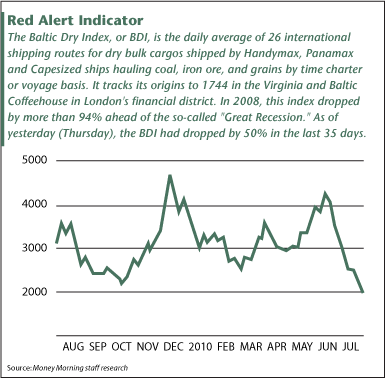
The Baltic Dry Index (BDI) flashed serious warning signals ahead of the 2008 financial crisis. After dropping for its 35th-straight day yesterday (Thursday), what is this thinly followed index telling us now?

Back in May 2008, when global investors still expected economic growth to continue, a thinly followed index began to broadcast a “red-alert” warning to those few who were watching.

The index proceeded to drop by more than 90% in the next six months.

Had you been watching – and heeded its warning – this index would have saved you from the fallout of the biggest financial crisis since the Great Depression.

And here’s the thing. This index is updated five days a week and is readily available to anyone who wants to track it.

The index in question is called the “Baltic Dry Index,” or BDI, and it once again merits a closer look: After peaking in May, the BDI has fallen for 35 straight days.

Is this another economic red alert, or merely a statistical red herring, like so many of the other economic reports that have appeared during the often-contradictory, whipsaw markets we’ve seen of late?

What is Baltic Dry index?

The Baltic Dry Index is a number issued daily by the London-based Baltic Exchange. Not restricted to Baltic Sea countries, the index tracks worldwide international shipping prices of various dry bulk cargoes.

The index provides investors and others with an idea of how much it will cost to move major raw materials by sea (in bulk, hence the name). Taking in 26 shipping routes measured on a time-charter and voyage basis, the BDI covers Handymax, Panamax, and Capesize dry bulk carriers shipping a plethora of commodities - including coal, iron ore, and grain.

If we look back at the BDI plunge that presaged the "Great Recession," we can see that outside events coincided with the index decline.
Crude oil peaked at an all-time high in a speculative frenzy in July 2008, and then reversed course. In September and October we witnessed the "big unwind," as Lehman Bros. Holdings Inc. (OTC: LEHMQ) collapsed, American International Group Inc. (NYSE: AIG) was torpedoed by its credit-default-swap (CDS) business, and mortgage giants Fannie Mae (NYSE: FNM) and Freddie Mac (NYSE: FNM) imploded.

The index kept dropping as shipping companies parked their fleets. It let anyone who was following it know - in advance - that things were continuing to get worse.

When the index finally bottomed in December 2008, it established a bottom so low that it represented the ability to rent a 1,000-foot ore-class ship for less than the cost of the fuel it would burn if left to idle for a day. Ships that chartered for $48,000 back in May can now be had for $18,000 a day, a Lombard Street Research analyst told The Economist.

To the investors who watched this index, all of this was pretty obvious. Unfortunately, not many investors were watching.
And now the BDI is flashing "Red Alert" once again.

The Return-Trip Ticket
As important as it is to understand that a crash is imminent, I believe it's just as crucial to be ahead of the game by understanding when a rebound is at hand. The Baltic Dry Index performs that early warning system function just as well. It had fully bottomed three months before U.S. stocks ended their sell-off. By January 2009, in fact, the BDI had signaled to "informed investors" that it was time to start nibbling again. As a fund manager working to navigate the crash, I made sure that my shop relied on this index: Along with some other tools, the BDI provided us with insights about how the U.S. and global economies were behaving. It provided us with a panoramic view of what global manufacturers were doing with their raw ore reserves.
That brings us back to the present.

Back on the Tarmac
The BDI most recently topped out in May. As of yesterday (Thursday), it has already dropped 35 days in a row. That's significant. This string of "down days" is the longest in at least nine years, The Economist reported this week. During the crash of 2008, the index never fell 35 days in a row. Today, the BDI is again flashing serious warning signs that not everything is as it appears. It may be warning us about the start of a "double-dip" recession, or it may be telling us that something even worse is at hand.

Historically, the Baltic Dry Index has shown itself to be the EKG of future industrial demand. And, right now, the BDI is screaming "Danger, Will Robinson!" to any investor who will read it and heed it as a true leading indicator.

If the price of refined copper is called "Dr. Copper," for its ability to ascertain the health of the demand for growth in an economy, the BDI is the daily heartbeat for near-term future industrial demand. Combined, those two indicators can provide investors with a view of whether the world economy is growing or shrinking, based on the big picture of world demand for growth. Currently, the BDI is flashing serious warning signs to anyone who is looking at it.

The drop in the BDI index in 2008 was one of the most obvious signs of the real impact that the so-called "Great Recession" would have. From May 20, 2008 to Dec. 3, 2008, the BDI fell from its high of 11,793 to its low of 663 - a near-freefall of 94%.

Moves to Consider Now


Given the signals we're getting from the Baltic Dry Index, the question to ask is clear: Are you preparing your portfolio so it includes protection against a possible additional leg down in the market?

It may help to understand the specific moves you'd want to consider.
Remember, back in 2008 the BDI had dropped for nearly two months before crude oil hit that July record peak and then started to unwind.

We will want to keep an eye on other raw commodity prices for similar "topping" actions, as we watch for confirmation of weakness in our favorite natural resources.
When demand is dropping for raw bulk materials, and the inventory of refined products like copper is growing, we will know it is time to consider putting in a "short" play on some of our commodity futures via long-dated put options.
Action to Take: The odds of a double-dip recession escalate even as volume dries up during summer trading. Put tight stops on any speculative position that you would be uncomfortable holding through a "2008-like" financial event that could strike this fall. You want to have enough liquidity to be able to buy when the next "March-2009-like" market bottom occurs. It won't play out just like the last one, but there will be similarities. You will need the financial firepower - cash - to take advantage of such a great possible entry point. Be prepared.

Wednesday, June 30, 2010

THE U.S. DOLLAR IS DOOMED - Get ready for New reserve currency

Russia buys another loads of gold
The most recent data on gold reserve holdings as presented by the World Gold Council, that Russia had purchased 27.6 tons of gold in the most recent reporting period, bringing its total to 668.6 tons. It appears Russia is only getting started. According to the latest IMF data, in the period between April and May, Russia added another 22.5 tons, bringing its May total to a fresh record of 703.1 tons. As BusinessWeek reports, Russia "has added gold every month since at least February."

IMF Website speaks of New World Currency
Finally, in principle, a new global currency issued by a global central bank, with robust governance and institutional features, could provide a nominal anchor and risk-free asset for the system independent of national currencies. This global central bank could also serve as a lender of last resort. But any such step requires considerably more debate on its merits, including on the need for a safety valve for the system given errors that might inevitably occur, as well as of its feasibility, given the very substantial multilateral effort required. I fear we are still very far from that level of global collaboration.

http://www.imf.org/external/np/speeches/2010/051110.htm

Thursday, May 20, 2010

24 Experts Warn Of Meltdown 2010 : Martial Law : Economic Collapse

Bob Chapman
First 6 months of 2010, Americans will continue to live in the 'unreality'...the period between July and October is when the financial fireworks will begin. The Fed will act unilaterally for its own survival irrespective of any political implications ...(source is from insider at FED meetings). In the last quarter of the year we could even see Martial law, which is more likely for the first 6 months of 2011. The FDIC will collapse in September 2010. Commercial real estate is set to implode in 2010. Wall Street believes there is a 100% chance of crash in bond market, especially municipals sometime during 2010. The dollar will be devalued by the end of 2010.
Gerald Celente
Terrorist attacks and the "Crash of 2010". 40% devaluation at first = the greatest depression, worse than the Great Depression.
Igor Panarin
In the summer of 1998, based on classified data about the state of the U.S. economy and society supplied to him by fellow FAPSI analysts, Panarin forecast the probable disintegration of the USA into six parts in 2010 (at the end of June – start of July 2010, as he specified on 10 December 2000
Neithercorps
Have projected that the third and final stage of the economic collapse will begin sometime in 2010. Barring some kind of financial miracle, or the complete dissolution of the Federal Reserve, a snowballing implosion should become visible by the end of this year. The behavior of the Fed, along with that of the IMF seems to suggest that they are preparing for a focused collapse, peaking within weeks or months instead of years, and the most certain fall of the dollar.
Webbots
July and onward things get very strange. Revolution. Dollar dead by November 2010.
LEAP 20/20
2010 Outlook from a group of 25 European Economists with a 90% accuracy rating- We anticipate a sudden intensification of the crisis in the second half of 2010, caused by a double effect of a catching up of events which were temporarily « frozen » in the second half of 2009 and the impossibility of maintaining the palliative remedies of past years. There is a perfect (economic) storm coming within the global financial markets and inevitable pressure on interest rates in the U.S. The injection of zero-cost money into the Western banking system has failed to restart the economy. Despite zero-cost money, the system has stalled. It is slowly rolling over into the next big down wave, which in Elliott Wave terminology will be Super Cycle Wave Three, or in common language, "THE BIG ONE, WHERE WE ALL GO OVER THE FALLS TOGETHER."
Joseph Meyer
Forecasts on the economy. He sees the real estate market continuing to decline, and advised people to invest in precious metals and commodities, as well as keeping cash at home in a safe place in case of bank closures. The stock market, after peaking in March or April (around 10,850), will fall all the way down to somewhere between 2450 and 4125 during the next leg down.
Harry Dent (investor)
A very likely second crash by late 2010. The coming depression (starts around the summer of 2010). Dent sees the stock market--currently benefiting from upward momentum and peppier economic activity--headed for a very brief and pleasant run that could lift the Dow to the 10,700-11,500 range from its current level of about 10.090. But then, he sees the market running into a stone wall, which will be followed by a nasty stock market decline (starting in early March to late April) that could drive down the Dow later this year to 3,000-5,000, with his best guess about 3,800.
Harold Eatmon (1990)
I had a vision of the stock market soar and then crash. After the crash, many big business corporations and private parties bought up stocks because of the low cost to buy in. Then I saw the market begin to climb again in a short period of time. Then it crashed again bringing tremendous loss, ruin and devastation to all who bought in the first time. This is what I have labeled "Two Black Mondays" . The time period between the Two Black Mondays was very close together. I could not tell exactly how close. There are some tell tale signs indicating the season and the setting. I saw the season to be when *"the leaves fall to the ground"* then the first crash would occur."Like Joseph in Genesis, I believe America will have fat years of financial blessing. I also believe there are coming lean years of financial difficulty for America. [Note: while this doesn't give an exact date, this prophecy was dead on accurate- the markets crashed -777 points on MONDAY 9/29/08, roughly 1 week into the FALL (leaves fall to the ground.) The markets then rebounded OVER A SHORT PERIOD OF TIME (from April 2009 to October 2009 the markets rallied nearly 4000 points!) and everyone bought back in. According to this prophecy, the next huge crash will happen on a Monday. Eatmon even accurately predicted the coming 'fat years' and the now present 'lean years']
Larry Randolph
... there is yet a seven-fold shaking of greater magnitude coming that will produce enormous and perhaps catastrophic disruptions on economic, political, geophysical, atmospheric, and spiritual levels.
Weather Bill
Huge earthquake in America in September 2010. This EQ to come is going to start the swift downfall of America
Andrey Rasshivaev
At the very end of the year of 2007 I have received a revelation from God that the coming 2008 year was going to be the year of the beginning of outpouring of God's judgment upon this world...About half a year ago God has given me a further revelation. He reveled me that the crisis was just the very beginning. The world is going to face the total and complete economical and financial collapse in August-September of this new 2010 year.
Greg Evensen
Economic meltdown and possible martial law in the mid summer 2010.
Rick Wiles
Use the first 6 months of 2010 to prepare for the last 3 months of 2010. Purchase everything you need while you still can. Pay off your debts. Judgment is coming upon America (she will be shaken physically, financially, and spiritually)- not the end of the USA, only TEOTUSAAWKI- supply chain will be disrupted for years, admitted insolvency- handed over to allies for pennies on the dollar. POSSIBILITIES: (not prophecies) EMP attack, China Russia NK cyber attack, delayed Y2K bug.
Sadhu Sundar Selvaraj
Starvation and famine/financial problems will develop. Terrorist attacks. Banks close. Tsunami. 7 new diseases worse than swine flu.
Amos Scaggs
The ultra-rich will go broke. I don’t mean go bankrupt I mean go broke, no money. I saw ultra rich people working for food because they were broke. This will happen by mid-February 2011.
Jimmy "Doomsday"
DOW will fall below 7,000 before mid summer 2010- Dollar will rise above 95 on the dollar index before mid summer 2010- Gold will bottom out below $800 before mid summer 2010- Silver will bottom out below $10 before mid summer 2010- CA debt implosion will start its major downturn by mid summer and hit crisis mode before Q4 2010- Dollar index will plunge below 65 between Q3 and Q4 2010- Commercial real estate will hit crisis mode in Q4 2010- Over 35 states will be bailed out by end of Q4 2010 by the US tax payer End of Q4 2010 gold will hit $1,600 and silver jump to $35 an oz.
Unnamed Economist working for US Gov't (GLP)
What we have experienced the last two years is nothing to what we are going to experience this year. If you have a job now...you may not have it in three to six months. (by August 2010). Stock market will fall = great depression. Foreign investors stop financing debt = collapse. 6.2 million are about to lose their unemployment.
Lindsey Williams
Dollar devalued 30-50% by end of year. It will become very difficult for the average American to afford to buy even food. This was revealed to him through an Illuminati insider.
Richard Mogey
Current Research Director at the Foundation for the Study of Cycles- Because of a convergence of numerous cycles all at once, the stock market may go up for a little while, but will crash in 2010 and reach all-time lows late 2012. Mogey says that the 2008 crash was nothing compared to the coming crash. Gold may correct in 2009, but will go up in 2010 and peak in 2011. Silver will follow gold.
Robert Prechter
Founder of Elliott Wave International, implores retail investors stay away from the markets… for now. Prechter, who was bullish near the lows in March 2009, now says the stock market “is in a topping area.”predicting another crash in 2010 that will bring stocks below the 2009 low. His word to the wise, “be patient, don’t rush it” keep your money in cash and cash equivalents.
John P. Hussman, Ph.D.
In my estimation, there is still close to an 80% probability (Bayes' Rule) that a second market plunge and economic downturn will unfold during 2010.
Robin Landry (Market Expert)
I believe we are headed to new market highs between 10780-11241 over the next few months. The most likely time frame for the top is the April-May area. Remember the evidence IMHO still says we are in a bear market rally with a major decline to follow once this rally ends.
Alpha-Omega Report (Trends Forecast)
Going into 2010, the trends seemed to lead nowhere or towards oblivion. Geo-politically, the Middle East was and is trending towards some sort of military clash, most likely by mid-year, but perhaps sooner...At the moment, it seems 2010 is shaping up to be a year of absolute chaos. We see trends for war between Israel and her neighbors that will shake every facet of human activity...In the event of war, we see all other societal trends being thoroughly disrupted...Iran will most likely shut off the flow of oil from the Persian Gulf. This will have immense consequences for the world’s economy. Oil prices will skyrocket into the stratosphere and become so expensive that world’s economies will collapse..There are also trend indicators along economic lines that point to the potential for a total meltdown of the world’s financial system with major crisis points developing with the change of each quarter of the year. 2010 could be a meltdown year for the world’s economy, regardless of what goes on in the Middle East.
Eric deCarbonnel
There is no precedence for the panic and chaos that will occur in 2010. The global food supply/demand picture has NEVER been so out of balance. The 2010 food crisis will rearrange economic, financial, and political order of the world, and those who aren’t prepared will suffer terrible losses…As the dollar loses most of its value, America's savings will be wiped out. The US service economy will disintegrate as consumer spending in real terms (ie: gold or other stable currencies) drops like a rock, bringing unemployment to levels exceeding the great depression. Public health services/programs will be cut back, as individuals will have no savings/credit/income to pay for medical care. Value of most investments will be wiped out. The US debt markets will freeze again, this time permanently. There will be no buyers except at the most drastic of firesale prices, and inflation will wipe away value before credit markets have any chance at recovery. The panic in 2010 will see the majority of derivatives end up worthless. Since global derivatives markets operate on the assumption of the continued stable value of the dollar and short term US debt, using derivatives to bet against the dollar is NOT a good idea. The panic in 2010 will see the majority of derivatives end up worthless. The dollar's collapse will rob US consumers of all purchasing power, and any investment depend on US consumption will lose most of its value.
WALL STREET JOURNAL- (2/2010)
"You are witnessing a fundamental breakdown of the American dream, a systemic breakdown of our democracy and our capitalism, a breakdown driven by the blind insatiable greed of Wall Street: Dysfunctional government, insane markets, economy on the brink. Multiply that many times over and see a world in total disarray. Ignore it now, tomorrow will be too late."
Lyndon Larouch
The crisis is accelerating and will become worse week by week until the whole system grinds into a collapse, likely sometime this year. And when it does, it will be the greatest collapse since the fall of the Roman Empire.
Niño Becerra (Professor of Economics)
Predicted in July 2007 that what was going to happen was that by mid 2010 there is going to be a crisis only comparable to the one in 1929. From October 2009 to May 2010 people will begin to see things are not working out the way the government thought. In May of 2010, the crisis starts with all its force and continues and strengthens throughout 2011. He accurately predicted the current recession and market crash to the month.
Richard Russell (Market Expert)
(from 2/3/10) says the bear market rally is in the process of breaking up and panic is on the way. He sees a full correction of the entire rise from the 2002 low of 7,286 to the bull market high of 14,164.53 set on October 9, 2007. The halfway level of retracement was 10,725. The total retracement was to 6,547.05 on March 9, 2009. He now sees the Dow falling to 7,286 and if that level does not hold, “I see it sinking to its 1980-82 area low of Dow 1,000.” The current action is the worst he has ever seen. (Bob Chapman says for Russell to make such a startling statement is unusual because he never cries wolf and is almost never wrong)

1-In-10 Home owners Will Lose Their Home To The Bank

New Observations is forecasting that a minimum of one in ten homes with a mortgage today will be lost to foreclosure in the next two years and that this loss represents a staggering five-million-unit addition to inventory-for-sale.
A record high 4.63% of mortgages were in foreclosure at the end of March The Mortgage Bankers Association reported Wednesday. Much worse, a mammoth 9.54% of mortgages are 90-days or more past due.
Given cure rates are slim-to-nothing-at-all beyond a 60-day delinquency, in practical terms, all of these seriously-delinquent homes will be lost through a sheriff’s auction, a short sale, a deed-in-lieu passing title from borrower to bank, or some other variant of distressed sale. Amherst Securities Group in a Sept. 2009 report said of the cure rate: “The cure rate on 60+ loans has decreased from 66% in early 2005 to 5% in Q2 2009.”
What is obvious and apparent from the cure-rate chart (see above-click for a clear view) is that borrowers who miss a payment are giving up quickly. After two payments are missed, the mortgage is a goner. It’s a new phenomena and adds a serious risk of falling prices for those who currently own homes.
If 50 million homes carry a mortgage, and with 10 percent lost to the bank in the next two years, five million units will be added to the current for-sale inventory. The five million bank-repo homes works out to about 10 months of sales at an average rate. Amherst estimated 7 million liquidations to the bank, but it was unclear over what period of time. The numbers will have even a more exaggerated impact if mortgage-payment performance continues to fall.
Current inventory is at eight months. The recent inventory high was 11 months in April 2008. Our figures already show current supply for-sale at 3.6 million units – which we have estimated is excessive by over 900,000 units (see chart “Units For Sale”-click for a clear view). In an average month 500,000 existing homes sell.
In another derogatory sign, purchase applications fell 27 percent to their lowest point since May 1997. A government-paid down-payment program ended April 30th.
The guesstimate that one-in-ten mortgage borrowers will lose their home is not a wild proclamation. It’s basic math based on the cure rate. What is wild is considering what will happen to real estate prices should mortgage failure gain greater momentum. Serious delinquencies are 30% greater today than a year ago.
A crash has the same irrational exuberance as a mania, except that greed is liberating and fear is terrifying. We have already lost 30 percent of house prices nationwide. There is simply no question that a radical loss in value may still lie ahead. Mortgage performance has gone down hill, and only a strong employment recovery can change the math

Tuesday, April 13, 2010

GREECE DOOM STILL ON! NO BAILOUT!!

As of today It's not confirmed that Greece is bailed out. Not all EU leaders agreed to it yet. This could still be doom. EU leaders haven't yet agreed unanimously to offer Greece a bailout, according to a Wall Street Journal report that offered details about the potential plan. But ministers have made the terms of a potential deal public in an effort to reassure world financial markets, which have been unnerved by Greece's debt woes for months.

Oops... ALL LEADERS WILL HAVE TO AGREE TO IT, probably even PASS LAWS IN THEIR OWN COUNTRIES to allow it...
Here is MSM version of this news
http://www.nasdaq.com/

"This decision today was no decision on aid for Greece," Finance Minstry spokesman Michael Offer told Dow Jones Newswires. "But it was only about technical preconditions for aid by further specifying the decision of the heads of state and governments. We expect, we hope that Greece is now in a situation where it can continue to refinance itself on the capital markets, as previously."


Doom still on!

Thursday, November 19, 2009

Double Dip Recession is looming, The evidence is piling up that all year we've been living in a dreamland


After publicly doubting recovery all through the summer and early fall, the housing bears are definitely getting their moment, after two key numbers (mortgages and starts) came in particularly weak yesterday.


Today the WSJ adds some further evidence that the much-feared "double dip" is happening.
On Wednesday Pulte Homes Inc., the nation's largest home builder, warned investors of a grim outlook. "As we look out to 2010, we are expecting difficult conditions to continue," said chief executive Richard Dugas.

Meanwhile, more Americans who bought homes during the boom are falling into mortgage limbo. About 3.4% of U.S. households -- or about 1.9 million homeowners -- are 120 days or more overdue on their payments, but not yet in foreclosure, according to LPS Applied Analytics, a research firm in Denver. That is up from 1.5% a year earlier.
Many of these people are likely to lose their homes over the next few years. That means more bank-owned homes will hit a market already suffering from oversupply.
The housing-supply picture is tricky to read. The number of homes listed for sale was 3.63 million in September, down 15% from a year earlier, according to the National Association of Realtors. That is enough to last about eight months at the current rate of sales. Anything above about six months is considered a buyer's market, in which prices may come under downward pressure.

Thursday, November 12, 2009

China reduced buying US Bonds, raising its own currency


China has sent the clearest signal yet that it may be about to scale back lending to the United States. On Wednesday, the Chinese Central Bank indicated that it would consider allowing the dollar to fall against the yuan. The change in policy—at a time when America is running the largest deficits in world history—could have major ramifications for the U.S.


The People’s Bank of China’s most recent policy report contained some interesting new language. Instead of repeating the typical rhetoric about keeping the yuan “basically stable at a reasonable and balanced level,” it hinted at a move away from the dollar peg (the mechanism by which it keeps the exchange rate of the yuan stable to the dollar).

The new policy language said that the bank will “improve the yuan exchange-rate formation mechanism,” based upon principles of “initiative, controllability and gradualism.” Analysts are interpreting this to mean that China may be about to allow the dollar to fall against the yuan.

“I think the wording change … shows that it is an irresistible trend for China to resume yuan appreciation,” said Xing Ziqiang, an economist at Beijing-based China International Capital Corp.

One of the ways China intervenes to keep the yuan pegged to the U.S. dollar is by purchasing dollar assets—like U.S. treasuries—in international currency markets. This increased demand for dollar assets, along with the subsequent increased supply of yuan, helps prop up the value of the dollar against the Chinese currency. However, if this relationship is about to change, and China is going to allow the dollar to fall in relation to the yuan, it means that China’s central bank will probably have to reduce its purchases of dollar assets.

If China curtails its treasury purchases, America may find itself in a pickle. China is America’s most important creditor. Over the past decade, China has willingly lent money to the U.S. government (by purchasing treasuries), so that the yuan would be artificially pegged at a low rate to the dollar. China did this to give an advantage to its exporters and encourage U.S. businesses to relocate to China. The advantage for America was that both the government and consumers had an easy source of borrowed money, and interest rates were kept low. This allowed both the public and private sectors of the U.S. economy over the past few years to embark on what was probably the biggest spending binge in history.

However, the downside to this arrangement may now be about to be felt. American society is addicted to debt. China’s announcement that it will let the dollar fall against the yuan is a warning that Chinese money might not be quite so easy to get. For the U.S. government, it means that it may need to find an additional source of foreign lenders—not an easy task when you are already the world’s largest borrower and you are running world-record deficits.

The U.S. is auctioning off another $81 billion in treasuries this week. This total is lower than other recent auctions, but it is still gargantuan compared to pre-economic-crisis days. This auction may not fail, but the probability that one will fail someday soon just got a whole lot more likely.

And if an auction were to fail? Interest rates could soar. For an economy addicted to debt at all levels—federal, state, municipal, corporate, personal—higher interest rates could be a killer.

Monday, November 2, 2009

The Orchestra Continues To Play As The Titanic Is Sinking

In 1912 nobody could have fathomed that the RMS Titanic, a purported unsinkable luxury liner, could have met its demise in an iceberg. As the Olympic-class passenger vessel descended into the sub-zero waters, the orchestra remained calm as they continued playing.

Today, like the oblivious orchestra players, most Americans remain blissfully unaware of how emaciated our economy has become. We continue to live under the fallacy that the United States is still a superpower. Now burdened by stifling debt, stymied by an obsolete industrial infrastructure and invaded by economic predators, we have somehow developed the same blinders the orchestra possessed, prohibiting us from seeing our imminent demise as we sit idly by, playing.

Americans are overlooking the rapid sell-off of our best wealth-producing companies; over 16,613 U.S. companies have been siphoned off by foreigners since 1978 alone. Many of these enterprises took over 100 years to develop, and everyday foreign acquirers spend over $200 million scooping up U.S. companies and landmarks.

We have already lost a huge percentage of our producing capabilities and our wealth generating companies in the midst of the Great American sell-off. Within the past five years alone, the U.S. has most notably lost Anheuser-Busch to Belgian-based InBev for $52 billion; Alcon, the world leader in eye care was usurped by Swiss pharmaceutical maker Novartis’ for $39 billion and KeySpan Corp. was bought out by British energy distributor National Grid for $11.8 billion.

The U.S. is currently fighting and losing an economic war that is prohibiting us from producing enough to support ourselves. We are being forced to live on imports and debt.

In June 2009, our own government will stop publishing a key report tracking foreign direct investments (FDI) into the U.S., essentially burying the problematic fact that America is for sale. Through the discontinuation of the Bureau of Economic Analysis’ (BEA) “New Investment Series,” the U.S. government and the American public will no longer be able to distinguish between FDI used to acquire existing U.S. assets from FDI used to establish new U.S. businesses. With the U.S. hiding the foreign money trail, the American public will no longer have the ability to track the rapid sell-off of the America’s best companies to foreign interests.

The U.S. is indebted more than $9.4 trillion. With each passing minute, the debt grows by almost $1 million or $1.4 billion a day. The top-four foreign holders of U.S. debt are Japan, China, Britain and Saudi Arabia. Together, these four nations hold around $2.3 trillion of national debt; Japan holds $517.2 billion while China holds nearly $405.5 billion. These numbers speak for themselves. Independence will be lost forever unless America becomes a productive exporting nation, backed by a strong industrial and manufacturing base.

Our foreign competitors have acquired much of their burgeoning wealth through our “free trade” policies. These countries have become our bankers. Now we can only afford to maintain our standard of living through the good graces of Japan, China, Britain and Saudi Arabia. Our foreign servitude has allowed us to live under the façade that we are wealthy. But it should be obvious that our former paradise has become a fool’s paradise as we produce less each year and watch as our best companies are ripped from our grasps. We currently sit on a massive pile of debt and imports. Our past glory days are distant memories, as the orchestra continues to play.

Wednesday, October 28, 2009

Bye bye dollar, Saudis nail it

Saudi Arabia on Wednesday decided to drop the widely used West Texas Intermediate oil contract as the benchmark for pricing its oil, dealing a serious blow to the New York Mercantile Exchange.

The decision by the world’s biggest oil exporter could encourage other producers to abandon the benchmark and threatens the dominance of the world’s most heavily traded oil futures contract. It is the main contract traded on Nymex.

The move reveals the growing discontent of Riyadh and its US refinery customers with WTI after the price of the price of the benchmark became separatedfrom the global oil market this year.

The surge in oil inventories in Cushing, Oklahoma, where WTI is delivered into America’s pipeline system, depressed the value of the WTI against other global benchmarks, throwing the global oil market into disarray.

In January, WTI, which usually trades at a premium of $1-$2 a barrel to Brent, fell sharply, leaving it at a discount of almost $12 – a record gap. This dislocation in the market continued well into the summer.

From January, Saudi Arabia will base the price of oil for its US customers on a new index developed by Argus, the London-based oil pricing company.

The Argus Sour Crude Index will track the price in the physical market of a basket of US Gulf Coast crudes, including Mars, Poseidon and Southern Green Canyon.

Argus said the change in policy reflected the “increased importance of the US Gulf coast sour crude market, in which both production and trading activity was rising sharply”.

Paul Horsnell, head of commodities research at Barclays Capital in London, said Saudi Arabia’s decision was likely to reflect a “wider discontent” from its customers in the US about WTI performance.

ExxonMobil, Marathon and Valero are among the US’s biggest buyers of Saudi crude oil.

Edward Morse, chief economist at LCM Commodities in New York, said: “It is a recognition by large players that WTI sometimes does not reflect the true value of crude oil in the waterborne market.”

Saudi Arabia has priced its oil using WTI since 1994.

The price was based on quotes from the physical market which were compiled by Platt’s, a unit of McGraw-Hill.

Oil companies then covered their exposure to WTI using the futures market on Nymex.

Bob Levin, managing director of market research at the CME Group-owned Nymex, said the exchange was ready to move with the market.

“We plan to introduce a cash-settled futures contract tracking the new Argus index,” he said.

Mike Vinciquerra, equity research analyst at BMO Capital Markets, said the new Argus index would not replace WTI. “It’s more a supplement,” he said

Wednesday, October 21, 2009

Not Peter Shiff, It is Karl Marx Right again

Owners of capital will stimulate the working class to buy more and more of expensive goods, houses and technology, pushing them to take more and more expensive credits, until their debt becomes unbearable. The unpaid debt will lead to bankruptcy of banks, which will have to be nationalized, and the State will have to take the road which will eventually lead to communism.

Karl Marx, Das Kapital, 1867

The great October fall of the US dollar is turning into an avalanche. On Tuesday, the American currency lost nine kopeks in Russia and reached a new minimum mark this year - 29.5 rubles per dollar. Within six months (April through September) the dollar lost over 10 percent at the world foreign exchange trading, which marked the sharpest decline since 1991. Some experts believe that the American currency is close to collapse, which may lead to a new financial crisis.

The tendency of the US dollar devaluation has been observed for a few years, but the current rate of decline is unprecedented. Some jokesters even rushed to re-read the letters of Karl Marx to Friedrich Engels written during the US financial panic of 1857 discussing the collapse of America. It would have been funny if it wasn’t so serious.

The chief economist of HSBC Bank Stephen King believes that if the US officials fail to stop the fall of American currency, it may provoke another financial crisis. “A dollar collapse would be a disaster all round… It would leave the international monetary system short of stability and long of fear. It would unleash economic upheavals on a similar scale to those seen in the 1970,” King wrote for The Independent.

American officials don’t seem to be overly concerned since nothing is being done about it. The US hasn’t done anything to support the currency since 1955. But is a collapse inevitable? From the viewpoint of macroeconomic indicators, the US state of affairs is, indeed, scary: record budget deficit of $1.4 trillion, record state debt that now exceeds $11.9 trillion, high unemployment and weak currency. Huge inflows of capital into the economy that Obama is proud of haven’t yet shown results.

But on the other hand, weak currency may be good for the US.

“The economy is supported by industrial orders based on the current weak dollar and higher prices in the future. Key players in the market are ready to support their manufacturers by weakening the currency,” says Alexander Kuptsikevich, FxPro financial analyst.

If the state debt is growing, it means that the US continues to obtain loans.

“Market participants prefer to borrow money in dollars, and dollar loans are relatively affordable. They invest into more active instruments denominated in currencies of developing countries,’ explains Yevgeny Nadorshin, chief economist of Trust Investment Bank.

This causes growth of stock index. For example, Russian Trading System increased by 34 percent within two and a half months.

World center banks, who used to be trusted American partners, also turn their backs to dollar. They reduced investments into assets denominated in American currency. According to Barclays Capital , in April, May, and June, the banks invested 63% of their gains in euro or yen. If it continues, this may lead to further devaluation of dollar.

However, central banks of the countries that depend on export try not to let it happen. For example, last week a group of Asian central banks carried out unprecedented intervention in the financial markets by actively buying American currency. Bank of Russia was not a passive observer either. According to experts’ evaluations, the bank purchased over three billion dollars.

The good thing about it is that it helped Russian manufacturers to maintain competitiveness and bank reserves. The question is whether we would have to spend much more when investors change their minds and flee the Russian market changing their rubles into dollars. Last year we paid a high price for it.

“I’m not afraid that the events of the last year will repeat. The circumstances now are different. The world touched the bottom of the crisis and revival began, so there won’t be sharp moves,” says profile manager of Pilgrim Asset Management Olga Izyumova.

Yevgeniy Nadorshin agrees with her. He also thinks that dollar will continue weakening. But many experts think that as soon as the US announces the raise of interest rates, American currency will stop falling and even start growing. When is it going to happen?

Ben Bernanke, the Chairman of the United States Federal Reserve evades the answer. All he says is that this will happen when the US is sure of stable growth. On Tuesday investors discussed information obtained from the US official sources that the Federal Reserve will start raising interest rates no earlier than the second half of the next year.

Wednesday, October 14, 2009

Next Great Bubble is about to bust - NYC Commercial Real Estate

This one's been in trouble for awhile, and now WSJ is reporting that the epic NYC apartment complex Stuyvesant Town is just months away from implosion.

The 56-building, 11,000 unit complex was acquired at the peak of the bubble for $5.4 billion by Tishman Speyer and BlackRock, with investors ranging from CALPERS (naturally) to the Church of England (not as obvious).

Here's the deal:
  • The property is now thought to be worth just $2.1 billion.
  • The buyers originally projected income would triple to $336 million in 2011, but right now it's only at $139 million.
  • They've got just $33 million cash on hand from its interest reserves to cover its debt, and a burn rate of $16 million.
So basically: they're screwed.

Meanwhile, this sad state of affairs explains why StuyTown is so eager to advertise on subways and magazines, in a desperate bid to gain tenants? Perhaps you want to help them out and live in converted public housing (which is what it is).

Monday, September 14, 2009

Global trade still in deep recession - Cargo Ships aren't moving anywhere


Off the coast of Singapore is a collection of ships larger than the U.S. and English navies just sitting idle, waiting out the recession. It's a spectacular image, capturing our bruised global economy better than any we've see thus far.

The Daily Mail has pictures of the idled fleet, and the full story about the decline in the world's trade business.

At this time last year one of the massive cargo ships carrying 80,000 tons of cargo would cost $50,000 a day. Now it's just $5,500. To send a 40 foot steel container of goods from China to the UK cost $300,000 in the summer of 2008. Now it costs just $10,000. The world could have 25% of its ships sitting idle in the next two years.

While the President says the economy has been pulled from the brink, and economists say the recession has ended, these ships floating in Asian seas are big reminder that we're still far off from recovery.

Simon Parry of the Daily Mail: The tropical waters that lap the jungle shores of southern Malaysia could not be described as a paradisical shimmering turquoise. They are more of a dark, soupy green. They also carry a suspicious smell. Not that this is of any concern to the lone Indian face that has just peeped anxiously down at me from the rusting deck of a towering container ship; he is more disturbed by the fact that I may be a pirate, which, right now, on top of everything else, is the last thing he needs.

His appearance, in a peaked cap and uniform, seems rather odd; an officer without a crew. But there is something slightly odder about the vast distance between my jolly boat and his lofty position, which I can't immediately put my finger on.

Then I have it - his 750ft-long merchant vessel is standing absurdly high in the water. The low waves don't even bother the lowest mark on its Plimsoll line. It's the same with all the ships parked here, and there are a lot of them. Close to 500. An armada of freighters with no cargo, no crew, and without a destination between them. Continue>

Friday, September 4, 2009

China is playing game - Derivative issue may go wild


There was a not insubstantial sell-off in commodity prices from light sweet crude to copper on Monday:


Much of it came down to a story put out by China’s Caijing magazine, which suggested the country’s state-owned Assets Supervision and Administration Commission (SASAC) might consider reneging on commodity derivative contracts that were now relatively deeply out of the money.

It said:
China’s state-owned enterprises may unilaterally terminate commodities contracts as they try to cut massive losses from financial derivatives, an industry source told Caijing on August 28. According to the source, China’s State-owned Assets Supervision and Administration Commission (SASAC) has sent notice to six foreign financial institutions informing them that several state-owned enterprise will reserve the right to default on commodities contracts signed with those institutions.

Keith Noyes, an official with the International Swaps and Derivatives Association, a trade organization, confirmed that he is aware of the matter, but provided no further comment. Foreign brokerages usually work through their Hong Kong operations to sign over-the-counter derivative hedging contracts, according to an investment banker whose firm is involved in the business. Hong Kong and Singapore usually serve as venues for arbitration over such transactions.

Most investment banks may “just swallow” any losses arising from canceled contracts, the executive said, adding that any losses are usually made up for with compensating trades. Investment banks “just earn less” from such transactions, he said. But any such move would be a major blow to investment banks which service massive commodities hedging operations for Chinese SOEs on the international market, said the executive.

Chinese SOEs have suffered massive losses from hedging contracts since the onset of the global financial crisis. SASAC and the National Auditing Office has been investigating derivatives positions trading since the beginning of the year. A source from a state-owned company told Caijing that most of China’s SOEs engaging in foreign exchange and international trade have participated in derivatives trading, involving capital topping 1 trillion yuan.


That reportedly also contributedto a 7 per cent sell-off in the Shanghai Composite on the day.

Now, considering China’s commodity purchases have helped support the global rebound to a large degree this year, there are some important implications not only for the six banks involved in outstanding contracts, but also for all current and prospective counterparties, to say nothing of the health of the global economy in general.

What’s more if the SASAC reneges there’s no telling what sort of precedent that would set for other Chinese companies.

This is not 10 years ago, after all. China has grown to become a critical trading partner for many western institutions, with many respective counterparties clearly under the impression that the days of contract “u-turns” were largely behind the country.

As for the losses themselves, it seems many in the market do believe the sums involved could be pretty substantial.

Could this, we wonder, be one of the reasons Chinese companies were so busy stocking up on cheap commodities in the first half of the year?

Thursday, September 3, 2009

World buying Gold like crazy! death of the dollar begin

Reports suggest that China's main sovereign wealth fund and other state entities are under pressure to invest in strategic Western assets as the country tries to offload its dollars for firmer-based wealth including gold and oil.

Several reports are coming out of China that there is pressure on state-controlled organisations - notably the country's main sovereign wealth fund, China Investment Corporation (CIC) to rapidly build investment in non-Chinese enterprises. While the CIC itself, with apparent access to some $300 billion in funds - and the possibility of more from the government - may be concentrating on hedge funds and other investment entities, there is another sector for Chinese state-owned companies looking at major investment in commodities. Indeed with the funds available as China seems to be dumping its US dollars in favour of more concrete assets, virtually no minerals sector is safe from Chinese participation.

While CIC was set up only two years ago, funded with $200 billion in initial capital, a report to the U.S. Congress noted that according to top Chinese officials, it was created to improve the rate of return on China's $1.5 trillion in foreign exchange reserves and to soak up some of the nation's excess financial liquidity. Depending on its performance with the initial allotment of $200 billion, the CIC might be allocated more of China's growing stock of foreign exchange reserves - and this has already proved to be the case.

Probably the most interesting of the recent reports of what is happening with Chinese sovereign wealth fund investment outside China has come from Paul Mylchreest's Thunder Road Report where an ex-U.S. intelligence service member is quoted. He reports that he has a friend who is in the Chinese Sovereign Wealth fund sector who says - hearsay I know and it wouldn't stand up in court - indicated that the wealth fund analysts were working all hours of the day and night trying to put investment deals together - particularly in the oil and precious metals sectors. The conclusion is that China recognises that the U.S. dollar is going to tank and it wants to convert as much of its trillions of dollars of holdings into strategic assets as possible before the collapse really takes hold.
The trouble is there is too much money available chasing too few assets - and too little time available - or such is the conclusion. As a result the Chinese government seems to be doing its utmost in trying to persuade the Chinese public to buy gold and silver by relaxing the restrictions - it's now easier to buy precious metals in China than in the U.S. - and by pushing gold and silver investment on state-owned television. If this continues the likelihood is that China will permanently overtake India as the world's biggest buyer of gold and silver, while the country's store of wealth will help shield it against further western economic collapse.
If this is indeed the case then it must be likely that the country is also building its own gold reserves - perhaps surreptitiously - through creative accounting by buying by a state entity, but not through the Central Bank itself where such sales would need to be reported. Positive for gold looking forward.
Returning to the Sovereign Wealth Funds angle though, CIC's chairman, Lou Jiwei, is reported by the WSJ as saying that investment in CIC's global portfolio for "one month this year equalled that of the whole of last year" and that given that the fund is expecting a positive return on its investments this year it may well ask the government for additional funding. Where it is going to place additional funding, who knows but there seems little doubt that China is using the western recession to buy up assets on the cheap and the funds available to do this are virtually unlimited by Western standards. But the Chinese won't buy up any old rubbish. They'll be looking for the crème de la crème.
Already CIC has bought 17% of Canada's last real remaining diversified miner - Teck Corporation - smartly buying when the latter was only just beginning to recover from last year's collapse and it has to be likely that more minerals-strategic investments are on the cards or being negotiated, either by CIC or other state organisations. Chinalco's ultimately thwarted move into Rio Tinto would have been another such instance and the Chinese investments and takeovers of Australian miners and promises of huge funding for minerals rich African countries are other examples.
Some reckon that China will be the world's second biggest economy, overtaking Japan, within the next couple of years and will overtake the U.S. by 2030. If it continues the way it is going and the U.S. continues the way it is going, this could happen much sooner. Communism, Chinese style, is winning the war of economic dominance and soon the world will no longer rely on the dollar as its reserve currency, but the renminbi!
In an interesting, but perhaps disturbing footnote to the Thunder Road Report mentioned above, Paul Mylchreest comments that in Latin America, where he has been living for 25 years, for the first time he can remember, locals are now preferring their own currency to U.S. dollars. He goes on to finish with this comment: "If a fellow with no education, a poor diet, and inadequate medical treatment living at 3,500 metres above sea level can figure out that the US dollar is undesirable as a store of wealth, how much longer do you think it can last as the world's reserve currency."
Your point to ponder for the day!

Tuesday, September 1, 2009

Congratulation - World just got New Currency!


At First here is the link to convert your currency to new SDR

YET ANOTHER BIG MOMENT IN HISTORY. THE SDR(Special Drawing Rights at the IMF or International Monetary Fund) is being made convertable into other currencies and the IMF beefing up their ability to service this type of request. If the article is even close to being right, the IMF is looking to increase their ability to leverage by a factor of 15 or more.. Going from gold reserves of 33bln to 283bln is HUGE and should be shouted from the rooftops if true..

In a new article on kitco, analyst Paul Nathan cites a report in Bloomberg that the IMF and representatives from China, Russia and Brazil voted to make the SDR (special drawing right) convertable to any currency. The first reserve of SDR's was created out of nothing at that vote, and is now availble to act as a neutral medium to move international currencies through. Anyone with a large horde of cash can now move it around the world at will, as long as the IMF give the say so. As I see it, this act cocks the gun for a bullet of massive, nation destroying inflation. Here's what Nathan says...

Late on a Friday in August, when most people around the world were not looking, the international monetary system, in an unprecedented move, evolved. We were notified by the IMF of the following:

Aug. 28 (Bloomberg) -- The International Monetary Fund said it today pumped about $250 billion into foreign-exchange reserves worldwide, acting on an April call from leaders of the Group of 20 nations to boost global liquidity.

Countries will be able to convert the money, to come from so-called Special Drawing Rights, into hard currencies through “voluntary trading arrangements” with other members, the IMF said on its Web site today. The SDRs are the institution’s unit of account based on a basket of currencies.

The allocation, approved by the IMF’s board of governors earlier this month, will not increase the fund’s pool of money available for lending, the IMF said. “It will, however, provide members with an additional method to obtain hard currencies.”

Another smaller reserves allocation of about $33 billion will take place Sept. 9 and will be limited to members that joined the lender after 1981, such as countries from the former Soviet bloc, the IMF said.

About $110 billion of the total allocation will go to emerging-market and developing countries and $20 billion to low- income nations.

“A number of members with sufficiently strong external positions” have already said they are ready to set up or expand existing arrangements enabling the sale or purchase of SDR's, the IMF said. The lender typically acts as a broker and arranges transactions between parties at no cost. (End News Release)

What this means is that for the first time in history we have a world central bank capable of creating money out of thin air. No longer does the IMF need to borrow money with a vote of all members plus the consent of the US congress. It can simply create whatever amount of money it needs through the creation of SDRs. Not for itself, mind you, but for the world. The SDR has been around since 1967, but never as a convertible asset. That changed Friday, August 28th, 2009. The SDR has quietly mutated.

The decision was made August 7th, in an IMF vote. According to the IMF "global reserves will increase from just USD33bn to USD283bn or about 4% of global reserves excluding gold. In addition, the IMF will start issuing SDR notes later this year (China, Brazil and Russia will be the main buyers). These SDR notes can be counted as part of currency reserves and hence SDR assets could reach 5% of total reserve assets later in 2009 and possibly surpass GBP, JPY and CHF in importance as reserve assets." This is a foot in the door.

The prospect of this happening was covered in my article, The Making Of An International Monetary Crisis:

"The spectacle of billions of inconvertible dollars frozen in the vaults of central banks has brought on cries of condemnation over the dollar’s credibility as a reserve currency. The Policy Maker’s theory of a stable yet artificially ever-expanding reserve currency has failed.
The "solution" to the problem (if the Policy Maker remains consistent) will be to evolve the international monetary system from a system in which an ever-expanding reserve currency provided the world with credit and liquidity, to a system in which an ever-expanding reserve "asset" will fill that role. Like the dollar, this reserve "asset" will amount to circulating debt, i.e. something owed rather than something owned. It will be a non-market instrument, deriving its acceptability from government cooperation and decree, "immune from the laws of the free market and outside the reach of greedy speculators."

Where will this "asset" come from? Under the Bretton Woods system, dollar reserves were furnished by the U.S. central bank. Both the bank and the "asset" failed to provide sufficient stability. The next step is to create a world bank (a larger bank of last resort) controlled by an international organization (the IMF) with the power to create a new "asset," independent of any single government’s monetary policy.

As a supplement to gold and like the dollar before it, this "asset" should be a credit instrument. Unlike the dollar, it would have the backing of an entire world of central banks. The "asset" should be ever-expanding and should provide both liquidity and stability." That asset is the SDR and the potential became a reality this weekend. (For a further discussion of creating international reserves and the SDR, see my articles The Making Of An International Monetary Crisis and Bretton Woods 1944-1971, under "Other articles" by Paul Nathan).

As of this weekend, the world is 250 billion dollars "richer". No products were produced. No taxes were raised. Not even one cent was borrowed. The IMF simply created a bookkeeping entry on behalf of those countries it felt worthy of receiving additional reserves. The reserves, SDRs, are a claim to "hard currency". The hard currency will be provided by those with "sufficiently strong external positions”, in other words, surplus nations.

There is no reason for surplus nations to part with hard currency, save two, that I can think of: Altruism or Power. And in my opinion they are having a go at the latter. My read on this is that the surplus nations have just made an end run around the United States and the US Congress who have veto power over IMF decisions. Surplus nations can now provide “voluntary trading arrangements” with non-surplus (importing) nations with the IMF as "broker". This sounds like a mechanism for the surplus nations to provide buying power to importing nations at the expense of us all.

The ability to inflate has now been augmented. It has transcended national boundaries from national central banks to a world central bank. This "new" bank now has the power to create money. Inflation is no longer limited to one currency but will affect all paper currencies in the world. We now have the prospect of a synchronized international inflation. It's not enough that citizens throughout the world had to keep a keen eye on their nations central bank, now we all need to keep an eye on the IMF.

The "IMF's Board Of Governors", a group never elected to office, unknown to most, and accountable to no one, has now gained the power to create new claims on production without legal limits or oversight from any regulatory body. All it need do is vote for more SDRs.

Given the "announcement in the dead of night" tactics just employed, I suggest we all sharpen our eyesight. This development doesn't change the inflation outlook for the next month or even for the next year. But make no mistake -- the "powers that be" just took the fiat system and the inflation threat to a new level.

CNBC September Calling - Get ready for a bumpy ride

The US recovery could be bumpy, but haven't we passed the point where credit markets threaten to completely freeze-up? Art Cashin of UBS trading appears to believe the worst is behind us.


"Now we've gotten back to basically pre-Lehman levels. The Lehman scare is out of the market."


So we're back to pre-Lehman, but markets are still below pre-Lehman. More ammo for those who believe stocks are too cheap relative to where we are today.


Sunday, August 30, 2009

New Banking Strategy - Micro financing vs Too big to fail


Despite the economic downturn, microfinance pioneer Grameen Bank continues to report nearly 100% payback rates for its loans to the very poor.

This bank, started by Nobel Prizer winner Muhammad Yunus, lends to people with zero credit, no collateral, and extremely low levels of income.

Aren't the poorest mass-defaulting due to recent economic hardship? Not at all.

AP: "We have now shown that the poorest of the poor can be creditworthy," he said in an interview with The Associated Press during a recent trip to Bangkok. "Our loan repayments are as high as ever."

One part of Grameen's success is that it involves many members of the same social group when approving and monitoring loans, increasing the social cost of default for the borrower. It also turns many borrowers into shareholders.

A group of five prospective borrowers from similar social and economic positions come together to determine an appropriate loan for each.The request then goes before a larger council of borrowers, who are also shareholders in the bank, and finally to the bank for approval."

Furthermore, the bank focuses on lending for productive assets, rather than for mere consumption or asset speculation. How amazingly obvious this bank's principles sound in retrospect.

Grameen also has been successful because it's grounded in what he calls "the real economy," rather than "fantasy economy" of ever-climbing asset prices. A loan for a goat, for example, produces tangible benefits that can support a family. "The closer you are to the real economy, the safer you are," he said.

While not everything could be scaled-up and applied to large traditional banks -- in doing so, you'd likely lose a lot of what makes this work -- the underlying concepts should be taken to heart.

Friday, August 28, 2009

Bailout Just failed - Peter Boettke


The long run inflationary consequences of the bailouts of our financial system has sent us on a path of national ruin, famed economist Peter Boettke argues.

Despite the short term gains in the stock market and what looks like the start of an economic recovery, the cycle of debt, deficits and government expansion will be economically crippling, he says

From Boettke:

If what the bailout and shift in both the traditional role of the Fed and Treasury perform have done is unleash this cycle of deficits, debt and debasement rather than constrain it (as it obviously has done!), then we have sent our national economic policies on a path of ruin that may well set us back for decades…
Government activism isn't the cure for the crisis, it is the cause.

Boettke says the Fed’s quantitative easing is a mistake because it is preventing market adjustments guided by relative pricing. What’s more, the government’s actions were predicated on the idea that we were experiencing a liquidity crisis when what we were really going through a solvency crisis. And the ad-hoc way the policies were created led to "regime uncertainty" as markets tried to guess what the government would do.

Here's how Boettke puts it:

Basic data presented by the Minn Fed, as well as discussed by Bob Higgs as well as Jeff Miron, Casey Mulligan and John Cochrane on issues related to liquidity, regime uncertainty, unemplyment composition, problems of moral hazard, effectiveness of fiscal policy, etc. have all at various times seemed to call into question the entire policy rationale used by economists and government officials. I am willing to be convinced that these empirical points are indeed wrong, but I have not been presented with such counter-claims on the data. Instead of critical engagement of the contending positions, we often just get in the blogosphere the separate claims presented. And in the instances where "debate" has in fact been encouraged --- such as the discussion between Brad de Long and Luigi Zingales, I found Zingales the more convincing presentation of economic argument.

Bottom-line, I don't believe we have seen a crisis of confidence, but instead a crisis of insolvency compounded by regime uncertainty caused by government's activism. In other words, we didn't have a credit lock-up a year ago due to liquidity issues, we had a credit lock-up due to regime uncertainty brought on by government decisions on who to bailout and who not to bailout for their bad decisions. Resources needed to be reallocated guided by price adjustment to bring production plans into alignment with consumption demands. Bailouts prevent the needed adjustments.

So not only am I dubious that the monetary policy the Fed has engaged in over the past year has been productive, I am extremely dubious that its expanded role beyond monetary policy in the economy. In fact, the dangers for the economy are significant, and as even discussed recently on both Tyler and my blog, the lack of a credible exit strategy makes it even more troublesome (remember those long-run consequences).